Guide · ETFs
Accumulating or distributing ETF: what changes in your taxes and records

Tortuga Trades · · 11 min
You often hear that an accumulating ETF “defers taxes”. It's true, but how much is that deferral worth in euros, and what changes in your records when the fund pays out instead of reinvesting? Let's look at it with Spanish tax rules, with a twenty-year example and with what each share class leaves, or doesn't leave, in your data.
Same fund, two share classes
An ETF collects the dividends of the companies it holds. What it then does with that money defines its share class. A distributingETF (its name usually carries “Dist” or “D”) pays it out to you: every quarter or every half-year, a payment lands in your account. An accumulatingETF (“Acc” or “C”) reinvests it inside the fund, and all you see is that the value of each unit grows a little more.
Often the same fund manager offers both classes on the same index, with the same portfolio. What you hold is the same; what changes is when the income reaches you and, with it, when it is taxed. Sometimes the fee differs a little too, but that is the core of it, and it isn't a small thing.
What is taxed in each case, and when
Spain's personal income tax law (the IRPF) treats separately the two kinds of income a fund can give you, ETFs included. Its article 94 distinguishes between the gains or losses that result from transferring the units and the results distributed by collective investment undertakings.
- A distributing ETF's payout is investment income (a rendimiento del capital mobiliario), just like a dividend (article 25.1.a), and it goes into the savings tax base for the year you collect it. Every year, whether you reinvest it or not. If your broker is a Spanish institution, it will normally withhold 19% when paying it: the regulations require a Spanish custodian of foreign securities to withhold. That withholding is an advance you deduct in your tax return, not an extra tax.
- An accumulating ETFgives you no income as long as you don't sell. When you sell, the difference between what you receive and what you paid is a capital gain or loss (a ganancia patrimonial), also in the savings base. And if you bought in several goes, the tax office assumes you sell first what you bought first: FIFO, as article 94 itself says.
Both kinds of income end up in the same base and under the same scale. As of October 2026, the savings scale (the state and regional halves added together, per articles 66 and 76) is this:
| Savings base | Rate |
|---|---|
| Up to €6,000 | 19% |
| €6,000 to €50,000 | 21% |
| €50,000 to €200,000 | 23% |
| €200,000 to €300,000 | 27% |
| From €300,000 | 30% |
So the difference isn't in the rate, but in the timing. The distributing ETF is taxed a little every year; the accumulating one, all at once, in the year you sell.
What deferral is worth: a twenty-year example
Suppose you invest €10,000 in an ETF that returns 7% a year: 5% from price growth and 2% in dividends. We compare its two classes, with the same portfolio and the same cost. To isolate the tax effect, the example assumes that in the distributing class you reinvest each year what is left of the payout after paying 19%, that in year 20 you sell everything at once with no other savings income (we tax the last payout separately at 19%, like the others; adding it to the sale would cost the distributing class about €14 more), and that the scale above doesn't change for twenty years. It is an example, not a forecast.
The first year shows the whole mechanism. The accumulating ETF goes from €10,000 to €10,700. The distributing one pays you €200, you pay €38 in tax, you reinvest €162 and end the year with €10,662. Those €38 no longer work for you, and the same happens every year.
The accumulating class ends up €761.49 ahead: a little over 2% of the result, after twenty years. Over ten years, with the same assumptions, the difference is about €80. Deferral is real, but slow: it shows with many years and high dividend yields, much less over a short horizon.
And notice a detail that runs against intuition: the accumulating class pays more tax, €5,906.34 against €5,504.75. Its advantage isn't paying less, but paying later, and having what you didn't pay keep growing. The flip side is the progressive scale: bunching the whole gain into a single year pushes it into the 21% bracket or higher, and selling over several years softens that.
Ireland: the withholding you don't see
Many UCITS ETFs are domiciled in Ireland; their ISIN tells you, because it starts with IE. That has two consequences worth keeping apart.
The first happens inside the fund. When a US company pays a dividend to an Irish fund, the United States withholds tax, and the treaty between the two countries caps it at 15%, according to the IRS treaty table. The fund bears that withholding, whether it distributes or accumulates, before the money reaches you. That is why it never shows up on your statement as a withholding line: it is a cost already netted out of the unit value or the payout amount.
The second happens on the way out. Ireland has a tax its funds may have to withhold on certain payments, the “exit tax”, but its tax authority explains that it isn't deducted on units held in a recognised clearing system, and adds that “this would be the case for an ETF”. Hence a payout from an Irish ETF usually reaches you with no withholding at source, unlike a dividend from an Irish company.
Switching class, and Modelo 720
Moving from the accumulating class to the distributing class of the same ETF, or the other way round, is a sale and a purchase: the gain is taxed, because there is no tax-free switch. On top of that, the two classes most likely count separately for FIFO. Spain's Directorate General of Taxes (DGT) reached that conclusion in ruling V0796-26, from April 2026, for two classes of the same investment fund that differed in their management fee: those classes cannot be considered homogeneous securities. ETF classes also differ in their payout policy, but there is no ruling on ETFs, or on classes that differ only in that, so treat it as the most reasonable reading, not a confirmed criterion.
On Modelo 720 (Spain's return for assets held abroad), the class changes nothing. According to ruling V1013-25, ETFs held with a foreign broker go into the 720 if the block exceeds €50,000, and you report the number and class of units and their net asset value at December 31. The rule doesn't distinguish between classes that pay out and classes that accumulate: both are reported the same way, each on its own line.
How each one looks in your records
The tax side has its mirror in the data. A distributing ETF leaves a cash trail: each payout is an entry with its date, its amount and, depending on the broker, its withholding. If you reinvest, each new purchase is a lot with its own date and its own cost, and the day you sell, FIFO will work through them in order.
An accumulating ETF leaves no entry at all. Its income is in the price: the only way to see it is the value of the position against what you paid.
That has a consequence that fools a lot of people. On the ex-date, the price of the distributing ETF drops by roughly what it is about to pay out, so if you compare the two classes only by their unrealized gain, the distributing one will always look worse. It isn't: it is missing what it has already paid you. To compare them you have to put price and payouts together.
What Tortuga does with each one
A distributing ETF's payout lands in Portfolio › Dividends like any other dividend: in the chart, in “Breakdown by company” and in the “Payments calendar”. With Interactive Brokers, DEGIRO, Trade Republic or XTB you will see the gross amount and the withholding separately, and you can switch between Net and Gross; ING only provides the net amount.
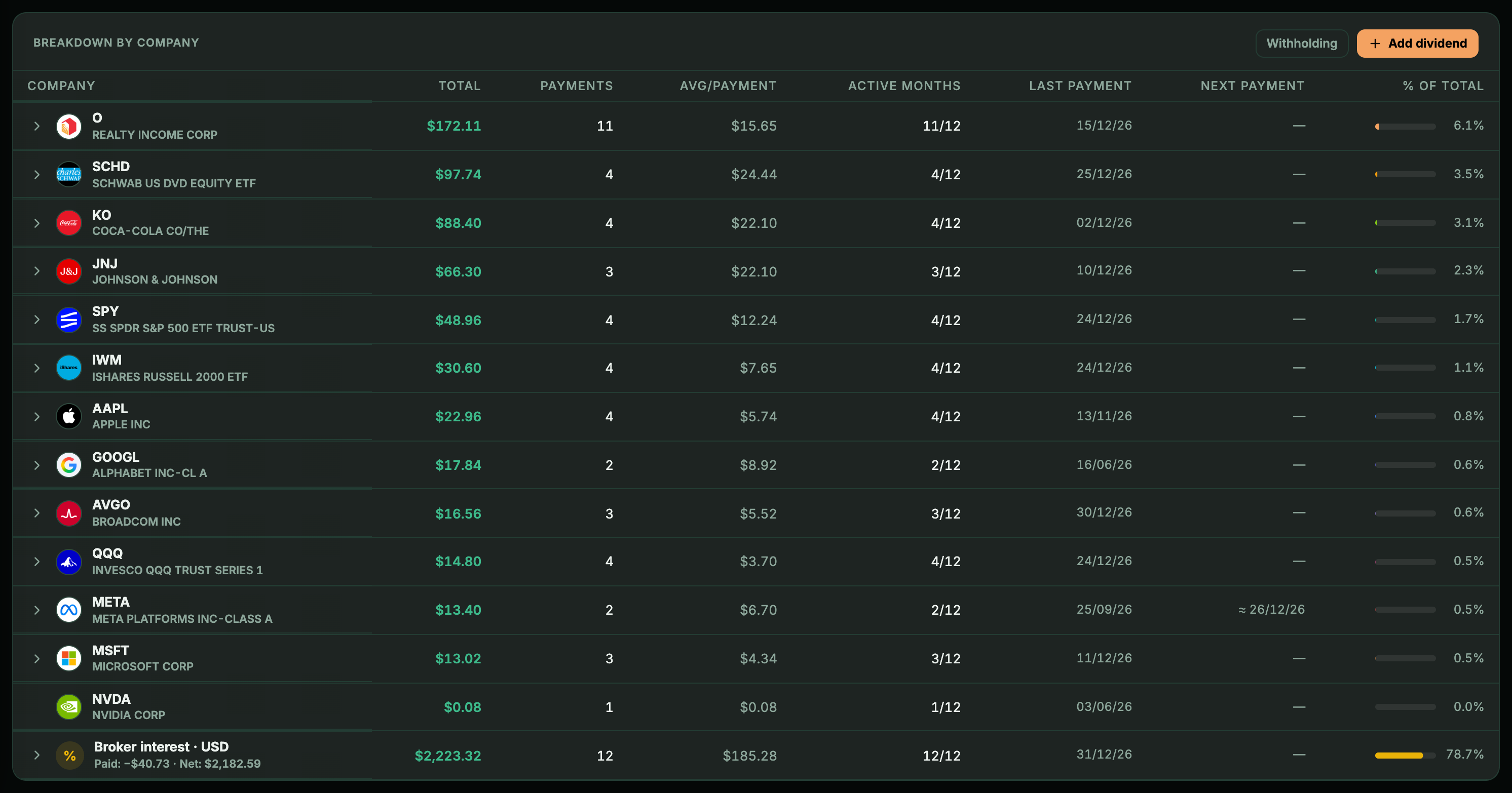
An accumulating ETF generates no payment, so it doesn't appear in Dividends and counts as zero in the PADI, the projected annual dividends. What it has earned you is visible in Portfolio, in its market value and its unrealized P&L.
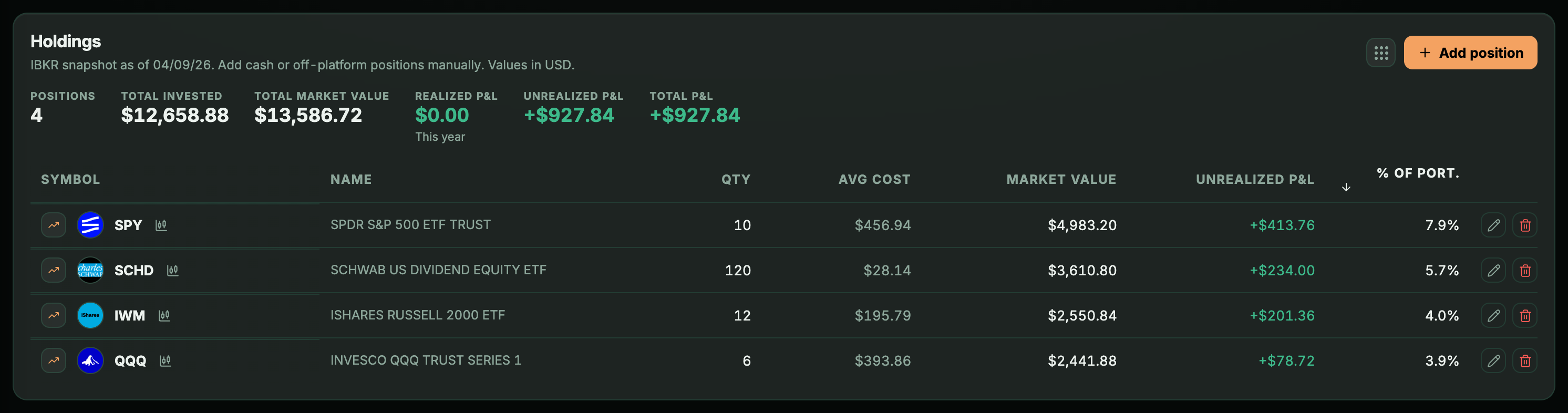
There are four things worth knowing to read those screens correctly:
- The ETFs tab depends on your broker.Tortuga separates ETFs from stocks when the broker identifies them as ETFs (Interactive Brokers, Trading 212, eToro). With brokers you import by CSV, such as DEGIRO or Trade Republic, a European ETF may show up as “Stock” in the Stocks tab.
- Tortuga doesn't flag whether an ETF is accumulating or distributing.You'll know from the fund's name or prospectus, or because its payouts appear in Dividends.
- It doesn't suggest a withholding rate for Irish ETFs, on purpose. Since a payout from an Irish UCITS ETF usually arrives with no withholding at source, suggesting the rate for Irish companies would be a mistake.
- There is no total return per position.The holdings table shows the unrealized P&L, and the payouts sit separately, in Dividends: to compare the two classes, add them up yourself. For the whole portfolio, on accounts with a daily net asset value from the broker (Interactive Brokers), the Tracker curve is a time-weighted return that already includes the dividends collected.
And a warning for tax time: the “Avg cost” you see in Portfolio isn't necessarily the FIFO cost the tax office asks for, and Tortuga doesn't generate reports for the IRPF or the 720. For your return, use your broker's reports.
Why the price drops on the ex-date is covered in the ex-dividend date. How withholding on dividends from foreign companies works, in withholding at source. And how to keep track of a whole year of payments, in dividend tracking.
Keep reading
- Covered call ETFs (JEPI, JEPQ and UCITS): where the payout comes fromClose to five out of every six euros of the income JEPI generates are option premium, not dividends. The UCITS versions with their ISINs, the upside you give up, how it is taxed in Spain and how it compares with selling the calls yourself.
- Foreign dividend withholding tax for Spanish residents: how much each country keeps and what you get backOut of a $100 dividend, $100 never reaches you. How much each country keeps, what you can deduct on your Spanish tax return, what you can only reclaim abroad, and where you see it on your Interactive Brokers statement.
- Tracking your Interactive Brokers dividends: received and projectedYour broker statement tells you what you have been paid. It doesn’t tell you what you will be paid, or how much already comes in without selling anything once you add interest and premiums.