Guide · ETFs
Covered call ETFs (JEPI, JEPQ and UCITS): where the payout comes from

Tortuga Trades · · 9 min
An ETF like JEPI pays out every month and advertises a yield of close to 8%. Where does that money come from, when the companies it holds pay nowhere near that much? Its own manager gives the answer: most of it is not dividends but premium from options sold. And that changes how you read it, how it is taxed and how you record it.
What a covered call ETF does under the hood
Let's start with what the prospectus says, not the marketing. JEPI's summary prospectus describes two pieces: an actively managed portfolio of stocks and, on top of it, the sale of call options with exposure to the S&P 500. JEPQ does the same on the Nasdaq-100, according to its own prospectus.
In the US version, the calls are not sold directly: they sit inside structured notes (ELNs, equity-linked notes) issued by banks, which can make up to 20% of the fund's assets. The prospectus warns that those notes carry counterparty risk. Both funds cost 0.35% a year, pay out monthly and are young: JEPI launched on May 20, 2020 and JEPQ on May 3, 2022.
In other words, a covered call ETF is a stock portfolio that rents out its upside: it collects a premium for agreeing not to keep everything the index gains, and it pays that premium out.
Where the payout comes from: the manager's own numbers
No guessing is needed here, because JPMorgan publishes it. In its JEPI presentation as of June 30, 2026, the average dividend from the stocks since launch is 1.43% a year, and the average option premium is 7.16%. Both figures are rolling 12-month averages, before fees.
Let's see what that means in money. Suppose €10,000 in the fund and a year that paid exactly those averages:
Close to five out of every six eurosof the income the fund generates come from premium, not from the companies. The manager sums it up as a "normalized" range: about 1–2% from dividends and 5–8% from premium. And it adds the condition that drives everything: in high volatility the premium grows; in low volatility, it shrinks.
That is why the yield figures move so much from one month to the next. In the factsheets as of August 31, 2026, the latest published as of October 2026, JEPI showed an 8.04% payout over the last twelve months and JEPQ 11.21% (JEPI factsheet, JEPQ factsheet). It is not a promise: it is what they paid, with the volatility there was.
What you give up in exchange
The premium isn't free, and the manager doesn't hide it either. Its own wording is that, in return for the premium, investors may forgo a portion of the market's upside. The prospectus is more precise: by selling a call, the fund caps its gain from a rise in the index at the strike price, plus the premium received.
Take two different years. If the index rises a little or falls, the premium is a cushion: it is collected anyway. If the index rallies hard, the call sold takes the part of the gain above the strike, and the fund falls behind. The factsheets of the European versions say it plainly: losses on the calls sold may offset what the stock portfolio gains.
So the useful question is not how much it pays out, but how much it returns in total: payout plus change in price. An 8% payout with a flat price is not the same as that same 8% in a year when, for example, the index rises 20% and the fund's price, half that.
JEPI from Europe: the UCITS versions
If you look for JEPI at a European broker with a retail account, it will most likely not let you buy the New York one. Why? The EU PRIIPs regulation requires that, before a packaged product is offered to a retail investor, its manufacturer draws up a key information document (the KID) and publishes it (Article 5(1)), and that whoever sells it hands it to you before you commit (Article 13(1)). A fund designed for the US market has no reason to have one, and without that document it cannot be sold to an EU retail investor. Each broker applies this its own way: check yours.
What does exist are Irish funds built on the same idea. As of October 2026, these are the main ones:
| Fund | ISIN | In euros (exchange) | Fees | Payout |
|---|---|---|---|---|
| JPM US Equity Premium Income Active UCITS ETF | IE000U5MJOZ6 | JEIP (Xetra); JEPI (Borsa Italiana) | 0.35% | Monthly |
| JPM Nasdaq Equity Premium Income Active UCITS ETF | IE000U9J8HX9 | JEQP (Xetra); JEPQ (Borsa Italiana) | 0.35% | Monthly |
| JPM Global Equity Premium Income Active UCITS ETF | IE0003UVYC20 | JGPI (Xetra); JEPG (Borsa Italiana) | 0.35% | Monthly |
| Global X Nasdaq 100 Covered Call UCITS ETF | IE00BM8R0J59 (distributing); IE00BM8R0H36 (accumulating) | QYLE (Xetra); QYLD (Borsa Italiana); distributing class only | 0.45% | Monthly (distributing class) |
Read carefully, the table hides three differences you can't see in the name:
- How they sell the calls.JPMorgan's UCITS funds sell the options directly, without the ELNs of the US JEPI. The Global X one is synthetic: it tracks a Nasdaq-100 buy-write index through a swap with Citi, so your exposure runs through that counterparty.
- Their history is different. The JPM US and Nasdaq UCITS funds launched on October 29, 2024; the global one on November 30, 2023. The 1.43% and 7.16% breakdown belongs to the New York JEPI, with data since 2020: it is the best clue to how the payout is made up, not a figure for the European fund.
- Not every class pays out.Global X has an accumulating class: the premium stays inside the fund and no payment reaches you. That changes the tax treatment, as we'll see now.
How the payout is taxed in Spain
Here is the paradox of these funds. Inside, the money is mostly option premium. But what reaches you is not a premium: it is a distribution from a fund, and Spain's income tax law (LIRPF) only looks at that. Article 94 attributes two things to the fund holder: what they gain or lose when selling their units, and the income the fund distributes. For an EU UCITS, that regime applies if it is registered with the CNMV (Article 94.2.a); even without registration, the payout is still income from a stake in an entity (Article 25.1.a).
Each monthly payout is therefore a rendimiento del capital mobiliario (investment income), like a dividend (Article 25.1.a), and goes into the base del ahorro, the savings tax base (Article 46.a). As of October 2026 that base is taxed in brackets: 19% up to €6,000, 21% up to €50,000, 23% up to €200,000, 27% up to €300,000 and 30% above that.
If your broker is a Spanish entity, the income tax regulation (RIRPF) (Article 76.1) requires it to withhold 19% on income from foreign securities that hasn't already been withheld in Spain. It isn't an extra tax: it is an advance you deduct in your return. And with the accumulating class there is no payout to report: the income shows up when you sell, as a capital gain. We compare both routes in accumulating or distributing ETFs.
What if you sell the calls yourself?
A covered call ETF does, at index scale, the same thing you can do with 100 shares of a company: sell someone the right to buy them from you at a set price. What changes? Let's see with an example. Suppose 100 shares bought at €50 and a call sold with a €55 strike for €1 per share: €100 of premium, before commissions.
| Price at expiration | What happens to the call | Result with the call | Without the call |
|---|---|---|---|
| €48 | Expires: you keep the premium | −€200 + €100 = −€100 | −€200 |
| €54 | Expires: you keep the premium | +€400 + €100 = +€500 | +€400 |
| €60 | Exercised at €55 | +€500 + €100 = +€600 | +€1,000 |
The third row is the cap the JEPI prospectus talks about: above €55, whatever the stock gains is no longer yours. It is exactly what the fund does, except that there you choose neither the strike nor the timing. And this other angle helps too: selling a cash-secured put has the same risk profile as a covered call, as we explain in selling puts.
Side by side, the two routes are alike at heart and differ in everything else:
| Covered call ETF | Your own calls | |
|---|---|---|
| Who picks the strike | The manager | You |
| Minimum to start | One unit | 100 shares per contract |
| How the premium reaches you | Inside the monthly payout | As premium, when you sell the option |
| How it is taxed | Investment income, on each payout | Capital gain or loss, when the option expires, is exercised or you close it |
| Cost | 0.35–0.45% a year | Commissions on each trade |
The tax row is the one people forget. The premium you collect is not taxed on the day you collect it: according to Spain's Directorate General of Taxes, it is attributed at expiration, exercise or close, and it also goes into the savings tax base. What a premium is worth and why is in the option premium; how to keep the books when calls chain with puts, in tracking the wheel.
How it looks in your records and in Tortuga
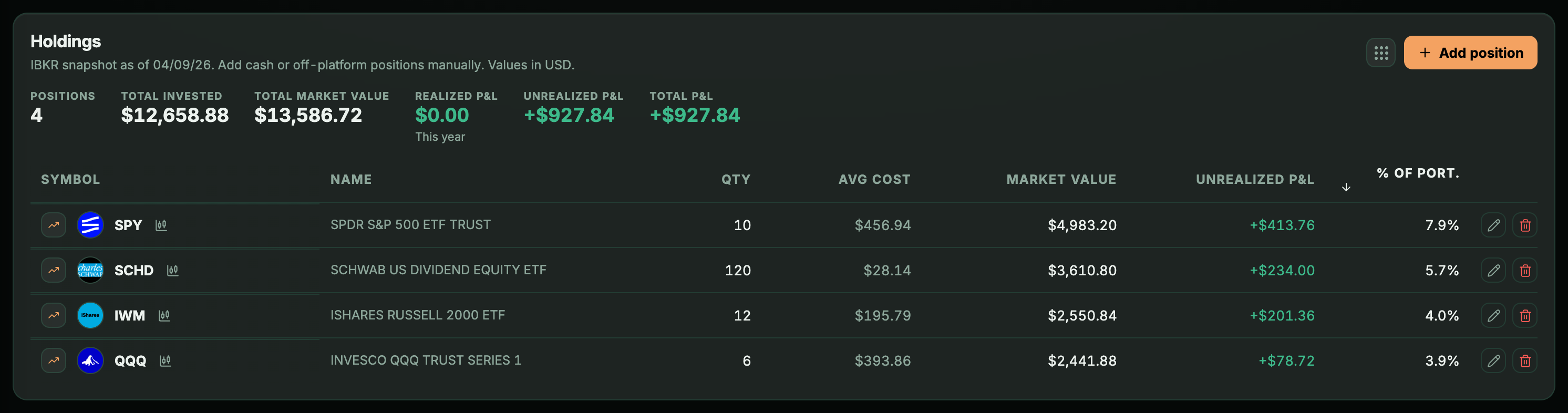
For your records, the practical rule is to log the ETF payout as what it is for tax purposes, a dividend, and to know from the manager's factsheet how much of it is premium. In Tortuga, an ETF payout lands in Portfolio › Dividends like any other dividend: in the chart, in «Breakdown by company» and in the payment calendar. There, a monthly payer you held for a full year shows 12/12 under «Active months» for that year.
In the «Upcoming dividends» list, Tortuga works out each payer's cadence from its latest ex-dates, and it labels JEPI and JEPQ as «Monthly». The PAIRR card puts your three income sources side by side: «divs X + int. Y + premiums Z»; and the «Income collected» card on the dashboard stacks dividends, premiums and interest month by month.

One thing to watch: Tortuga does not split the premium from the dividend inside JEPI's payout. The whole payout is one dividend line, because that is how the fund pays it to you. Only the premiums from your own options go into «Premiums».
With those options of your own, Tortuga labels the sold call «Covered Call» when you hold at least 100 shares per contract, and books its result in «Premiums» when the option expires (the full premium) or you close it (the premium minus what you paid to buy it back, which can be negative). With Interactive Brokers there is an exception: if your call is exercised, the broker folds the premium into the result of selling the shares, and it doesn't show up in «Premiums». In Portfolio › Options › «Underlyings» you will see that event as «CC called» if your account brings the broker's positions snapshot (Interactive Brokers or the tastytrade API) and you still hold shares of that company; if all of them were called away, the underlying no longer shows there. DEGIRO options are not imported: you can enter them by hand.
With Interactive Brokers, the ETF goes to the ETFs tab in Portfolio because the broker identifies it as one; with other brokers, Tortuga relies on lists and corrections, so a European ETF may show up as a stock.
Keep reading
- Selling puts: what it means, what you risk and how to record itWhat selling a put means, how much you can lose, what Interactive Brokers requires, and why an assignment leaves you with two purchase prices: the economic one (strike − premium) and the Spanish tax one.
- Accumulating or distributing ETF: what changes in your taxes and recordsAccumulating defers tax, but by how much? Spanish rules, a 20-year example, the Irish withholding you never see, and what each share class leaves in your records and in Tortuga.
- The premium: what you really collect or payQuoted at 2.00, but you collect 198.70. The ×100 multiplier, commissions and the three levers that make a premium large or small.