Guide · Dividends
Foreign dividend withholding tax for Spanish residents: how much each country keeps and what you get back

Tortuga Trades · · 8 min
This guide is for tax residents of Spain. When a US company pays you a dividend of 100 dollars, 100 don't reach your account. How many do? It depends on three things worth looking at together: the country that pays, the broker that collects and a form you sign once and forget about.
Three layers in every dividend
A foreign dividend passes through three hands before it stays in yours, and each one takes something or gives something back. Let's take them in order.
- The source country withholds.Before the money leaves, the company's country keeps a percentage. Each country has its own: 30% in the United States, 35% in Switzerland, nothing in the United Kingdom, except on its REITs.
- The tax treaty sets a ceiling.Spain has tax treaties with those countries that limit what they can keep from a Spanish resident: almost always, 15%. Whatever is withheld above that ceiling, the Spanish tax authority (Hacienda) won't let you deduct: you recover it by claiming it from the source country.
- Spain collects its share and deducts what was paid abroad. In your income tax return (the «renta»), the dividend is taxed in the savings base, and from that tax you can deduct what you already paid abroad, up to a limit.
In other words, withholding isn't one number, but several. One part Hacienda lets you deduct in your tax return; another you only recover if you claim it from the source country; and another depends on paperwork that had to be done before getting paid, not after.
A €100 dividend, step by step
Let's see it with numbers. Suppose a €100 gross dividend from a US company —in euros, so as not to mix currencies—, collected at a foreign broker that doesn't withhold anything in Spain, and a savings base of less than €6,000, which is taxed at 19%.
The result is the same 19% you would pay on a Spanish dividend. That is what the deduction is for: so you don't pay twice for the same thing. The rule is in article 80 of the IRPF law (Spain's personal income tax): you deduct the lower of what you paid abroad and what that income is taxed in Spain.
Now redo the math without the W-8BEN. The United States withholds 30%, so €70 arrives; but Hacienda only lets you deduct up to the treaty's 15%, so in your tax return you pay the same €4. In total, €34 of tax instead of 19: the extra €15 can only be recovered by claiming it from the United States, with its own form.
And if your broker is Spanish, you will also see a 19% withholding in Spain, calculated on what arrives after the source-country withholding: in the example, 19% of €85, €16.15. It isn't an extra tax, but an advance: in your tax return it is deducted in full: with just this dividend, your return would come out €12.15 to be refunded, and the total is still €19. A foreign broker that doesn't operate in Spain through a permanent establishment, such as a branch, isn't required to withhold anything from you; you declare it yourself all the same.
Country by country
These are the countries that show up most in a Spanish portfolio, with what each one withholds, the treaty ceiling and what you can claim there if too much was withheld:
| Country | Withholds | Ceiling | What you claim there |
|---|---|---|---|
| United States | 30% (15% with the W-8BEN) | 15% | Nothing with the W-8BEN; without it, 15 points (IRS, form 1040-NR) |
| United Kingdom | 0% (20% on REITs) | 10% (15% on REITs) | Nothing; on REITs, 5 points (form UK-REIT DT-Individual) |
| Netherlands | 15% | 15% | Nothing |
| Germany | 26.375% | 15% | 11.375 points (BZSt, online only) |
| France | 12.8% (25% if you're not identified as an individual) | 15% | Nothing; if 25% was withheld, 12.2 points, down to 12.8% (form 5001) |
| Switzerland | 35% | 15% | 20 points (ESTV, form 90) |
| Italy | 26% | 15% | 11 points (forms for non-residents) |
| Canada | 25% | 15% | 10 points (CRA, form NR7-R) |
| Ireland | 25% | 15% | All of it, with the exemption of form V2A, certified by the AEAT (the Spanish tax agency) |
| Portugal | 28% | 15% | 13 points (form 22-RFI) |
Read calmly, the table says three things. First: in the United States, the Netherlands, France and the United Kingdom —except for its REITs— there is nothing left for you to claim if your paperwork is in order.
Second: in Switzerland, Germany, Italy, Canada, Portugal and Ireland, the withholding exceeds the ceiling, and whatever goes over it is lost if you don't claim it; in Ireland, with the V2A, you can even recover all of it. Third: each country has its own form and its own deadlines, and claiming a few euros may not be worth the hassle.
The form that expires
The W-8BEN is the statement with which you tell the United States that you aren't a resident there and that you are claiming the treaty. With it, the withholding drops from 30% to 15%; without it, the broker applies 30%, as Interactive Brokers itself warns.
The important thing is that it expires. According to the IRS instructions, it is valid until December 31 of the third year after the year it was signed: one signed in 2026 is valid until the end of 2029. If you suddenly see 30% on your US dividends, the first thing to check is whether it has expired.
Where it shows up in your statement and your tax return
In the Interactive Brokers activity statement, the dividend and the withholding go in separate sections: «Dividends» and «Withholding Tax». Each broker presents it in its own way, but what you need to find is always the same: the gross dividend, what the source country withheld and, if any, what Spain withheld.
In the Renta 2025 tax return (the Spanish income tax return for 2025), according to the order that approved the form, the gross dividend goes in box 0029, the deduction for tax paid abroad in box 0588 and, if tax was withheld in Spain, that withholding in box 0597. Box numbers change from one year to the next: check the ones for your tax campaign.
And the savings base rate, from which the Spanish tax comes, rises in brackets: 19% up to €6,000, 21% up to €50,000, 23% up to €200,000, 27% up to €300,000 and 30% above that. Above €6,000, the deduction doesn't change, but what you pay in Spain does go up: in the 21% bracket, €6 for every €100 instead of 4.
What Tortuga does with this
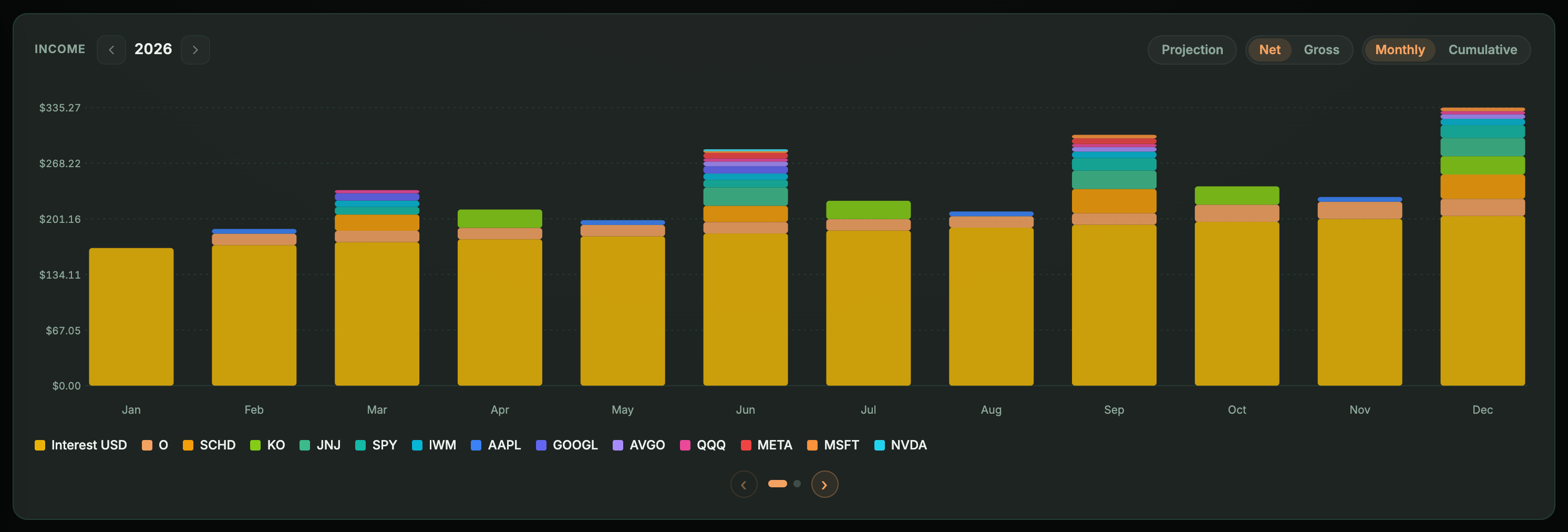
With Interactive Brokers, DEGIRO and Trade Republic, Tortuga stores the withholding on each payment, and in Portfolio › Dividends you can view your dividends net or gross. The toggle explains it like this: «Net: after withholding tax. Gross: what the broker statement shows». With ING only the net amount arrives, and with tastytrade the withholding comes in as a negative entry that already subtracts it: with both, Net and Gross show the same figure.
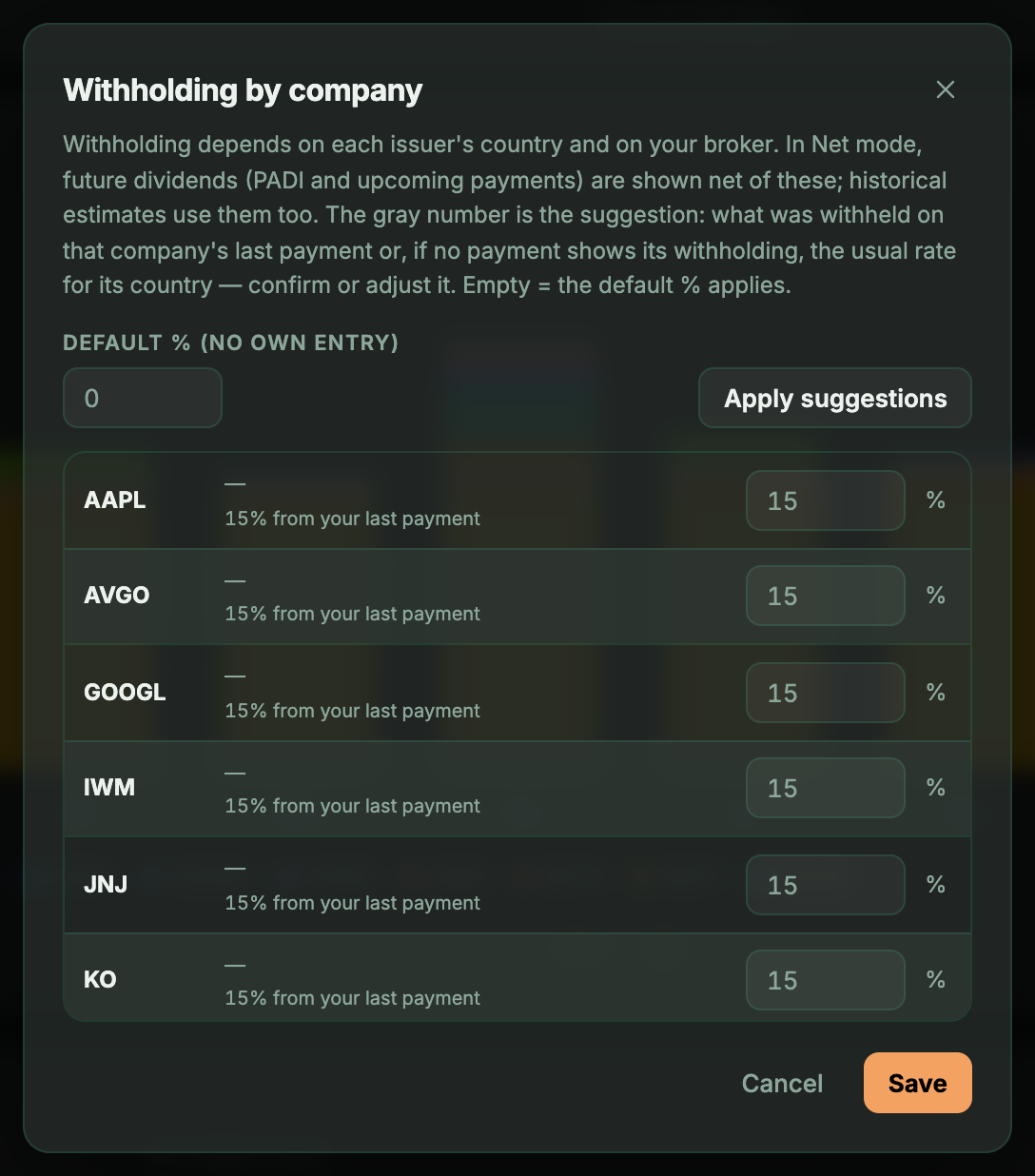
In the Withholdingeditor, next to «Add dividend», you can set the percentage each company withholds from you; in Net mode, Tortuga deducts it from what you haven't collected yet, the PADI and upcoming payments. What Tortuga doesn't do is your tax return: it doesn't generate reports for the IRPF, so for the boxes use your broker's reports.
Why your portfolio drops more on the ex-date than what you later collect is covered in the ex-dividend date. And how to keep track of the whole year, collected and projected, in dividend tracking.
Keep reading
- Ex-dividend date: the last day you can buy and still get the dividendThe payment date doesn’t tell you whether you get paid; the ex-dividend date does. In New York it matches the record date, in Madrid it falls one business day earlier, and on the ex-date your portfolio drops without that money being lost.
- Tracking your Interactive Brokers dividends: received and projectedYour broker statement tells you what you have been paid. It doesn’t tell you what you will be paid, or how much already comes in without selling anything once you add interest and premiums.
- Iberdrola’s scrip dividend: what to do with your rights and what happens to your cost basisTwice a year Iberdrola asks what you want to do with your dividend, and if you don’t answer, it chooses for you. The three options, which number changes in your portfolio with each one, and how each is taxed.