Guide · Dividends
Ex-dividend date: the last day you can buy and still get the dividend

Tortuga Trades · · 7 min
Up to what day can you buy a stock and still collect its next dividend? The payment date doesn't answer that question. The one that does is the ex-dividend date, and it is worth keeping in mind from the start an easy mistake to make: going by the record date, which works in New York and leaves you out in Madrid.
Three dates, three questions
The same dividend has three dates, and each one answers a different question. Let's take them in order.
- The ex-dividend date. It is the first day the stock trades without the right to the next dividend. If you buy on that day or later, that dividend is no longer yours; if you sell on that day, you still collect it.
- The record date. It is the day the company checks who is on its books as a shareholder to know whom to pay.
- The payment date.It is the day the money reaches your account. It doesn't decide who gets paid, only when.
In other words, the record date decides who gets paid; the ex-date, until when you can buy to be on the record. And the rule that follows is short: to get paid, you have to buy before the ex-date, at the latest on the previous business day.
Why there is one day's difference, or none
The ex-date exists for a mechanical reason. When you buy a stock you don't become its owner on the spot, but when the trade settles, and settlement takes one or two business days.
In Spain, today, it takes two business days: this is what is called T+2. If you buy on a Monday, you are on the books as a shareholder on Wednesday.
To be on the record you have to buy, at the latest, two business days before the record date, and that is why the ex-date falls on the business day before the record date. It is the example given in BME's corporate events guide: if the 2nd is the last day with the right, the 3rd is the ex-date and the 4th, the record date.
In the United States, since May 28, 2024, settlement takes just one day: T+1. If you buy the day before the record date, you make it in time, and that is why there the ex-date and the record date are the same day.
| New York (T+1) | Madrid (T+2) | |
|---|---|---|
| The ex-date falls… | on the same day as the record date | one business day before the record date |
| Last day to buy and get paid | the day before the record date | two business days before the record date |
| If you buy the day before the record date… | you get paid | you don't get paid: the purchase settles too late |
Here is the mistake I mentioned at the start. If you go by the record date and buy the day before, in New York you get paid and in Madrid you are left out. If you go by the ex-date, on the other hand, the rule is the same in both places: buy before it.
It is clearer with real dates. BBVA paid, in April 2026, a dividend of €0.60 per share: the last day to buy with the right was Tuesday the 7th; the ex-date, Wednesday the 8th; the record date, Thursday the 9th, and the payment, Friday the 10th. In New York, Johnson & Johnson paid $1.34 per share on September 8, and its ex-date and its record date were the same day: August 25.
Two exceptions in the US. If the record date falls on a non-business day, the ex-date is the previous business day. And when the dividend is very large —25% of the price or more—, the ex-date moves to the business day after the payment date.
What happens to your portfolio on the ex-date
On the ex-date, the stock usually opens cheaper, by roughly the amount of the dividend. It makes sense: whoever buys on that day no longer gets the dividend, so they pay less for the stock.
Cboe itself defines the ex-date as the first day the price drops to reflect the dividend. And in the US the rules require brokers to reduce by that amount the price of buy limit orders that are still open, unless the customer asks otherwise (FINRA Rule 5330).
In your portfolio, that shows up as a drop. But that money hasn't been lost: the value that has left the stock is the dividend you are going to collect. Put another way, the money has only changed place: from the share price to a pending payment.
Two nuances, because the math isn't exact. First: the price also moves with everything else that happens that day, so the drop rarely matches the dividend to the cent. Second: you won't collect the whole dividend, but the dividend minus the withholding, and that difference does come out of your pocket (it has its own guide: how much is taken from your foreign dividends).
Interactive Brokers reflects this in the statement: while a dividend is pending payment, it appears as accrued —under «Open Dividend Accruals»— and it already counts toward your account value. The drop in the share price is offset, to a large extent, by what you are owed.
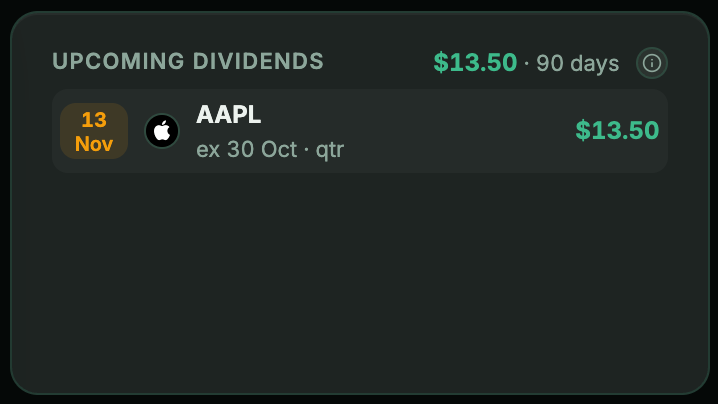
In Tortuga, every dividend you import from your broker goes onto your calendar on the day it was paid to you. And on the dashboard you can add, from the «+», the Upcoming dividends card, which shows the payments for the next 90 days and, when it is already known, the ex-date of each one, which marks your deadline: buy, at the latest, on the previous business day.
If you have sold calls on that stock
There is one case in which the ex-date affects you even if you don't plan to buy or sell: if you have sold calls on the stock. Options on US stocks can be exercised before expiration, and whoever holds that call has a good reason to do so the day before the ex-date: to keep the dividend.
The math they do is simple, and Cboe itself explains it: if the call is in the money and the dividend is greater than the time value it has left, exercising pays off. If someone exercises, the clearinghouse allocates the assignment among the sellers and it may fall to you: you deliver your shares at the strike price before the ex-date, and the dividend goes to whoever exercised.
In practice, if you sell covered calls on dividend-paying stocks, the day before each ex-date is a day to check your portfolio. What exactly happens when you get assigned is in what happens at expiration.
To know which months you get paid, and not just the next dividend, continue with your portfolio's dividend calendar.
Keep reading
- Dividend calendar: how to build your portfolio’s and get paid every monthThe market calendar tells you who pays this week; your portfolio’s tells you whether you will get anything in March. How to build it separating announced from estimated, and how to fill the empty months.
- Foreign dividend withholding tax for Spanish residents: how much each country keeps and what you get backOut of a $100 dividend, $100 never reaches you. How much each country keeps, what you can deduct on your Spanish tax return, what you can only reclaim abroad, and where you see it on your Interactive Brokers statement.
- What happens when an option expiresThree outcomes, not two. Exercise, assignment and expiration, with the buyer’s and the seller’s numbers side by side.